
Moisture-tested floors for the Capital City
Epoxy Flooring in Baton Rouge, LA
Garage, shop, patio and commercial coatings chosen for wet air, hot summers and slabs that have seen high water.
- Free on-site estimates, with the slab moisture-tested before we recommend a system
- Written, itemized quotes that list every prep step and coat
- Surface prep explained up front: grinding, crack repair and dew point checks
Coatings Built Around Baton Rouge Weather
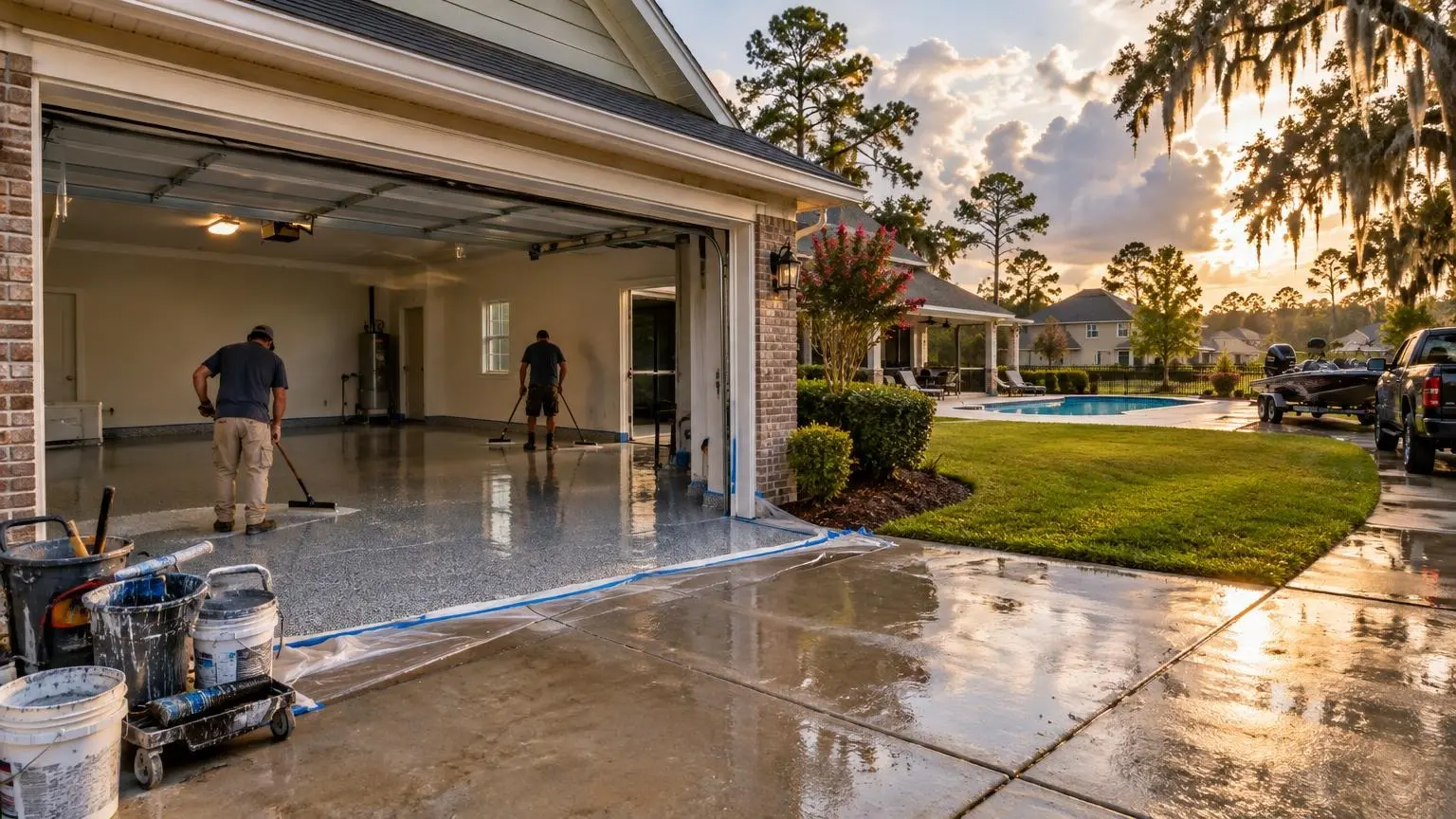
Good epoxy flooring in Baton Rouge starts with a moisture reading, not a color chart. We coat garages, carports, shops, warehouses, patios and pool decks across East Baton Rouge Parish and the towns around it, and every one of those slabs lives in the same thick, wet air. A floor that is put down with that in mind will shrug off hot tires, mud, spilled drinks and pressure washing for years. A floor that ignores it can lift, cloud or peel in its first summer.
What the climate does to a slab
Baton Rouge is a humid subtropical city. Wikipedia's climate table puts average annual relative humidity at 73.8%, climbing to about 77% in July and August, with 61.94 inches of rain spread over roughly 114 wet days a year. The same source lists the city fifth among the wettest in the country. For a concrete floor, that means two things. Vapor rises from the ground into the slab, and warm, damp air rolls across the surface every time the garage door opens.
The second problem is the dew point. Coating guidance from industry suppliers says to keep the slab at least 5 F above the dew point while a coat goes on and begins to cure. On a 75 F morning at 80% humidity, the dew point sits near 68 F, so a 70 F slab is too close and should not be coated. In a city that averages close to 74% humidity, mornings like that are not unusual. We carry a meter and take the reading; a bad number means the mixing buckets stay closed until it improves.
Floors after flood water
The city itself sits on the Istrouma Bluff, the first natural high ground upriver from the delta, but much of the metro is flat and low. In August 2016 a stalled storm dropped 31.39 inches of rain on Watson, just northeast of town, and the Amite and Comite rivers hit record crests. An estimated 146,000 homes across Louisiana were damaged, and many of them were outside high-risk flood zones. If your garage took on water then, or in any storm since, tell us. Flood water can leave cracks, salt deposits and weak patches that need repair before any epoxy floor coating goes down. A seamless, bonded coating is also easier to clean if water ever returns, because there are no tile seams or open pores for silt to settle into.
Heat, sun and the occasional freeze
The city has recorded 110 F, and July averages 83 F across day and night. Hot concrete shortens the working time of most resins, so summer jobs usually start early. Sun through an open west-facing door will yellow a plain epoxy over time, so garage floors and anything outdoors get a polyaspartic top layer that holds up to UV. Cold is rare, but not unheard of: the record low is 2 F, and January 2025 brought record snowfall. A well-bonded coating handles that range without trouble as long as the slab under it was prepared properly.
What it costs
Epoxy flooring cost comes down to three things: how big the floor is, what shape the concrete is in and which system you choose. HomeGuide's national guide puts installed epoxy at $4 to $10 per square foot, and its two-car garage range is $1,600 to $5,800. A 20x20 garage is 400 square feet, so it usually falls inside that two-car range. For a 1,000 or 1,500 square foot floor, multiply the area by the per-foot rate as a starting point, then add any repair work. HomeGuide puts polyaspartic at $5 to $12 per square foot, and metallic epoxy runs $5 to $12 according to This Old House. Removing an old coating, filling cracks and adding flake or grit all move the number. We measure and test before we price, and the written estimate is the price.
What to ask epoxy flooring contractors
Baton Rouge has plenty of epoxy flooring companies, from national franchises to one-truck crews, and their quotes can look very different. Ask any epoxy floor installer the same short list. Will you test the slab for moisture, and how? Will you diamond grind, or only acid etch? How do you handle cracks and control joints? Which coats go on, and which one is the topcoat? How do you check dew point on install day? How many days until foot traffic, and how many until a car can sit on it? A clear answer to each of those tells you more than a low number does. Ours are written into every quote.
The honest downsides
People often ask what the downside of epoxy flooring is. A gloss floor can be slick when wet unless grit or flake is added. Standard epoxy yellows in sunlight. Epoxy needs days, not hours, before you drive on it. And no coating can fix a slab that is pushing up too much moisture; it will only show the problem sooner. We plan around each of these with the right system, a textured finish where people walk wet, a UV-stable top layer, and a primer built for damp concrete whenever our meter shows the slab needs it.
Matching the system to the floor
We install six systems, and the slab and the job decide which one we suggest. A working garage usually gets an epoxy base with a full flake broadcast and a polyaspartic topcoat. A household that needs the garage back fast may want a full polyaspartic system. A game room or show garage may suit metallic epoxy. Shops, warehouses and service bays call for heavier-build commercial coatings finished with a topcoat that shrugs off chemicals. Patios, porches and pool decks need UV-stable, textured finishes, never plain indoor epoxy. Each service page below explains one system in detail, including published cost ranges.
How we use the garage here
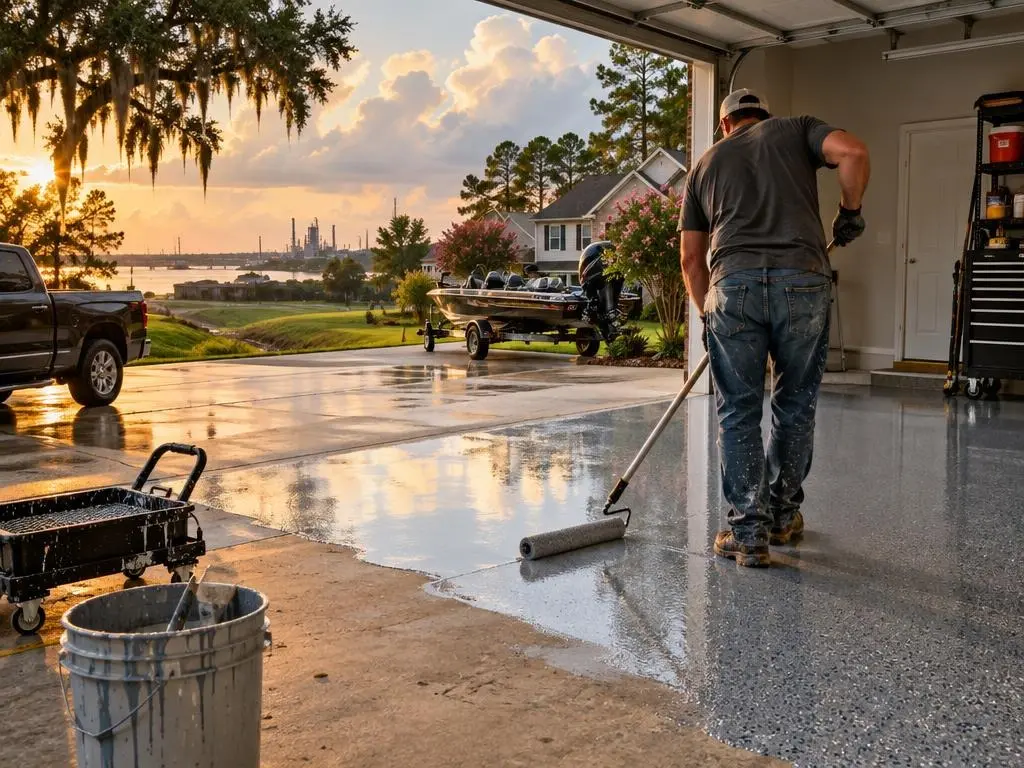
Baton Rouge garages work hard. Bass boats and trailers drip river water, ice chests and grills roll out for LSU game days, and plenty of people run a workshop or a home gym in one bay. Close to six in ten homes in East Baton Rouge Parish are owner-occupied, so most of our customers plan to live with the floor for a long time. Before recommending a system, we find out what actually happens in that garage, because a flake floor for a boat and a metallic floor for a man cave are very different jobs.
Why Homeowners Call Baton Rouge Epoxy Flooring
Moisture readings before any recommendation
We test the slab in more than one spot, and when the numbers come back high, a damp-tolerant primer goes under everything else. In a city this humid, that step decides whether a floor lasts.
Dew point checked on install day
We measure air temperature, humidity and slab temperature before each coat, and we reschedule if the slab is too close to the dew point.
Diamond grinding, not shortcuts
Concrete is ground to an open profile so the coating can bond. Cracks and broken joints get patched and leveled ahead of any resin.
Quotes you can compare line by line
The written estimate breaks out every prep task, every layer and the final figure, which makes side-by-side comparison with other bids simple.
Common Questions
What would 1,000 square feet of epoxy flooring run?
HomeGuide puts installed epoxy nationally at $4 to $10 per square foot; multiply your area by that rate for a first estimate. That guide lists polyaspartic at $5 to $12 per square foot. Crack repair, coating removal and moisture primers raise the figure, and we price your floor after measuring and testing it.
What does epoxy on a 20x20 floor usually cost?
A 20x20 floor works out to 400 square feet, which is roughly a two-car garage. HomeGuide lists two-car garage epoxy at $1,600 to $5,800. Where yours lands depends on the slab condition and the finish you choose.
How much does a 1,500 square foot epoxy floor cost?
Start with HomeGuide's $4 to $10 per square foot and multiply by 1,500. Large commercial floors may need a thicker 100% solids system, which HomeAdvisor prices from $12 per square foot upward. We give a written figure after a site visit.
What are the weak points of epoxy flooring?
Plain epoxy can be slippery when wet, it yellows under sunlight, and it needs several days before you park on it. It also cannot hold back a slab with too much moisture. A textured or flake finish, a polyaspartic topcoat and a moisture test before work begins deal with each of these.
Can you coat a garage in Baton Rouge humidity?
Yes, but not on every day. We check the dew point and slab temperature before each coat and keep the slab at least 5 F above the dew point. On muggy mornings that often means starting later or moving the date.
My garage flooded in 2016. Can it still be coated?
Usually. We look for cracks, salt residue and soft spots left behind, grind and repair them, and take moisture readings, which decide the primer. The quote tells you exactly what the slab needs.
Do you install outdoor epoxy on patios and pool decks?
Yes. Outdoor floors get a UV-stable polyaspartic system or a textured coating, not plain epoxy, because sun and standing rain are hard on standard epoxy. See our patio, porch and pool deck page for details.
Towns We Cover Around the Capital
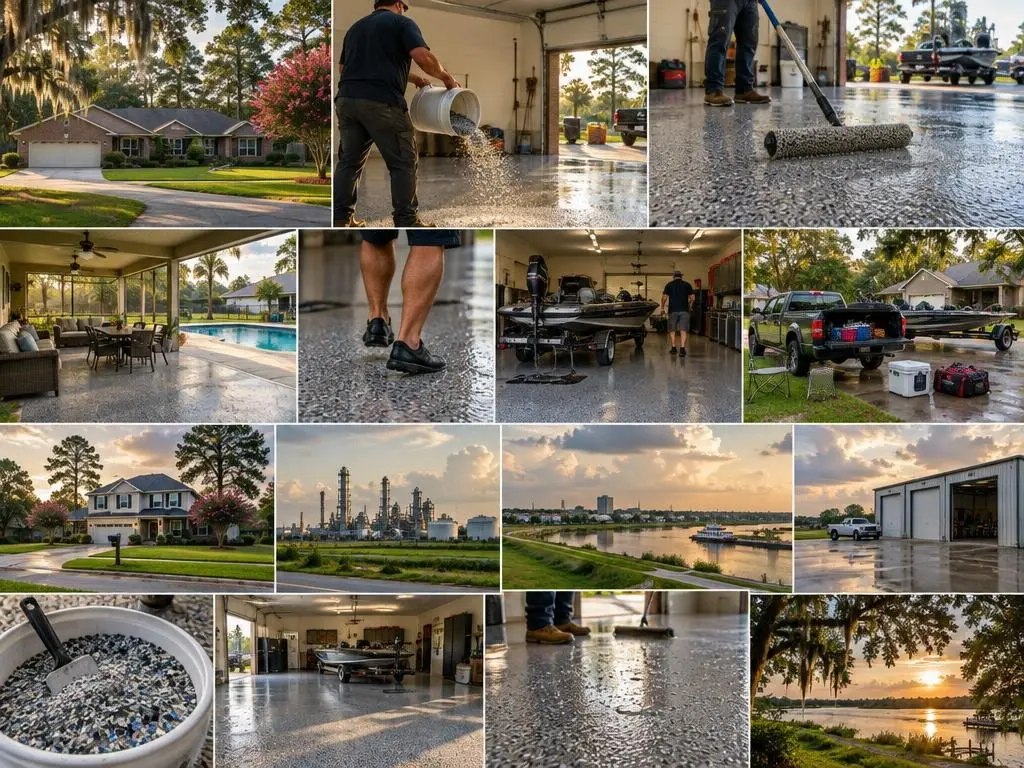
Our work is centered on Baton Rouge and the rest of East Baton Rouge Parish, including Baker, Central, Zachary and the St. George area neighborhoods of Shenandoah, Inniswold, Oak Hills Place, Westminster and Old Jefferson, plus Gardere and Merrydale. South and east we cover Prairieville, Gonzales, Sorrento and St. Gabriel, along with Denham Springs, Walker, Watson, Livingston and Hammond along the I-12 corridor. Across the river we work in Port Allen, Brusly, Addis and Plaquemine. Each area has its own floor issues: river-bottom slabs that flooded in 2016, brand new subdivision concrete still drying out, older carports in established neighborhoods, and industrial floors near the plants and the port.
- Epoxy Flooring in Baton Rouge, LA
- Epoxy Flooring in Prairieville, LA
- Epoxy Flooring in Gonzales, LA
- Epoxy Flooring in Denham Springs, LA
- Epoxy Flooring in Walker, LA
- Epoxy Flooring in Zachary, LA
- Epoxy Flooring in Central, LA
- Epoxy Flooring in Baker, LA
- Epoxy Flooring in St. Gabriel, LA
- Epoxy Flooring in Port Allen, LA
- Epoxy Flooring in Brusly, LA
- Epoxy Flooring in Addis, LA
- Epoxy Flooring in Plaquemine, LA
- Epoxy Flooring in Shenandoah, LA
- Epoxy Flooring in Oak Hills Place, LA
- Epoxy Flooring in Inniswold, LA
- Epoxy Flooring in Westminster, LA
- Epoxy Flooring in Gardere, LA
- Epoxy Flooring in Merrydale, LA
- Epoxy Flooring in Old Jefferson, LA
- Epoxy Flooring in Watson, LA
- Epoxy Flooring in Livingston, LA
- Epoxy Flooring in Hammond, LA
- Epoxy Flooring in Sorrento, LA
Our Epoxy Flooring Services
Six coating systems for Baton Rouge homes and businesses, each picked for the traffic a floor sees and the moisture its slab shows on the meter.
Garage Floor Epoxy
A ground, primed and sealed garage floor that handles hot tires, river mud and humid mornings.
Learn more →Flake Floor Coatings
Vinyl chip broadcast floors that hide dust, grip wet feet and hold up to boats, carts and game day traffic.
Learn more →Polyaspartic Garage Floors
Quick-curing and sun-resistant, this coating is often ready for use within roughly a day and keeps its color in UV.
Learn more →Metallic Epoxy
Pearl-like swirled floors for game rooms, home gyms, offices and shops that want a finish people notice.
Learn more →Commercial & Industrial Floor Epoxy
Thick, chemical-resistant concrete floor coatings for shops, warehouses, plants and service bays.
Learn more →Patio, Porch & Pool Deck Coatings
Textured, UV-stable coatings and pool deck resurfacing for outdoor concrete that bakes in sun and sits in rain.
Learn more →Ask for a Free Floor Estimate
Expect a slab measurement, a moisture test and a written quote. Phone (225) 267-9687 or use the form.